


Performance-review season is approaching. Across tech companies, the annual or twice-yearly cycle will soon absorb weeks of attention from the people responsible for getting work done.
Employees will reconstruct their accomplishments. Managers will collect peer feedback, write narratives, defend ratings, and negotiate promotions. Leadership teams will spend hours discussing people whose work they have never directly observed. Then the manager will return to the employee and explain a decision shaped by some combination of performance, budget, salary bands, and the strength of the argument made in the room.
We call this feedback.
For the person receiving it, the immediate questions are usually more concrete: What happened to my compensation? Am I being promoted? Does my manager still want me here?
If you lead a company, the period before the cycle begins is a useful time to ask what all this work actually buys. Once the calendar fills and the forms open, the process becomes surprisingly difficult to question.
I think we have allowed the performance review to become a substitute for several things managers should already be doing. The cost goes well beyond the hours spent writing it.
What the review is trying to do
There are at least four different jobs inside a conventional review: help someone improve, establish a record of their contribution, allocate compensation and promotions, and manage employment risk.
Each needs a different conversation.
Coaching requires enough trust for someone to admit uncertainty. Compensation discussions invite people to present the strongest possible case for themselves. Documentation requires factual accuracy. Promotion requires a judgment about sustained scope and readiness. Putting all of this into one document does not resolve the conflicts. It makes the employee responsible for navigating them.
Consider the request for a candid self-assessment. The company asks an employee to describe weaknesses in a document that may influence their compensation. A rational employee learns to disclose the weaknesses that sound like strengths, or the ones already visible to everyone.
We should not be surprised when the result is uninformative.
Useful feedback can be a gift, particularly from someone whose judgment you trust. A delayed verdict, delivered after the consequential decisions have already been made, is something else. Especially when the words have no clear connection to the outcome.
A manager who has withheld a concern for six months has already failed at the feedback part. Writing it carefully in December does not recover the lost time.
This is also why I do not believe in scheduled one-on-ones as the default. A concern waits for the meeting, or the meeting arrives with nothing worth discussing. Both people then feel obliged to fill the time.
I prefer frequent check-ins and conversations around common work. Obstacles become visible there, decisions can be examined, and other concerns surface naturally. A standing one-on-one can create an artificial separation between doing the work together and talking about it.
This requires more of the manager. You have to initiate conversations, stay accessible, and make time when something matters. Sensitive issues need privacy. Development needs deliberate attention. Neither should wait for a scheduled slot.
The compensation conversation has its own obligation to honesty. A strong performer near the top of a salary band may receive a smaller increase than someone further down the band. A promotion may be justified while the budget is constrained. The company may simply be unable to pay what it would like.
Those are real constraints. Describing them as a deficiency in the employee’s performance is where the damage begins.
The cost is management attention
The software invoice is easy to find. The time consumed across the organization is usually not.
Take an illustrative company with 500 employees. Suppose each review consumes five hours of manager research and writing, two hours of self-assessment, ninety minutes of peer input, a 45-minute conversation counted for both participants (ninety person-minutes), and two hours of calibration and administration allocated per employee.
That is twelve person-hours per employee. Six thousand hours per cycle. At an assumed fully loaded cost of $150 an hour, the labor cost is $900,000. A second comparable cycle would repeat it.
These are assumptions, not an industry benchmark. Replace them with your own. Include the 360 requests, the promotion packets, the revisions after calibration, and the conversations after the official conversation. Count meeting participants, not just meeting duration.
Then consider what is missing from the calculation: decisions delayed, difficult issues left untouched until the cycle, and relationships between managers strained by negotiating against one another for a fixed pool of recognition.
The question is whether those hours produce decisions good enough to justify what they displace.
Tools like Lattice hardly address that question. They organize the work, enforce the deadlines, and make completion visible. They can also make a questionable process more rigid: a field becomes mandatory because it exists; a reminder becomes an obligation; the dashboard becomes the definition of success.
As of November 2026, Lattice lists its Foundations package at $13 per seat per month. At that list price, 500 seats would cost $78,000 a year before any of the human work begins. The same pricing page highlights a customer’s increase in review participation from 62 percent to 100 percent. That establishes participation. It does not, by itself, establish better management. Lattice pricing
The most revealing example comes from Lattice itself. In 2023, it replaced its own traditional biannual review cycle after finding the process too burdensome and insufficiently useful for feedback. It continued using Lattice, but changed the management design. Lattice’s account
I think that is the right order of operations. Decide what management needs to accomplish, remove unnecessary work, and then choose tooling. Buying a more complete workflow before answering those questions can leave the company paying to preserve the problem.
When the curve overrides the work
Calibration has a legitimate purpose. Managers have different standards. Some avoid difficult conversations. Others consistently underestimate people whose work is less visible. Comparing evidence can expose both.
The problem starts when the room has to produce a predetermined distribution.
Suppose the template is 10 percent at the top, 70 percent in the middle, and 20 percent at the bottom. Other companies use different proportions. The exact percentages are less important than the assumption that every team should approximate them.
Teams are not random samples drawn from the company.
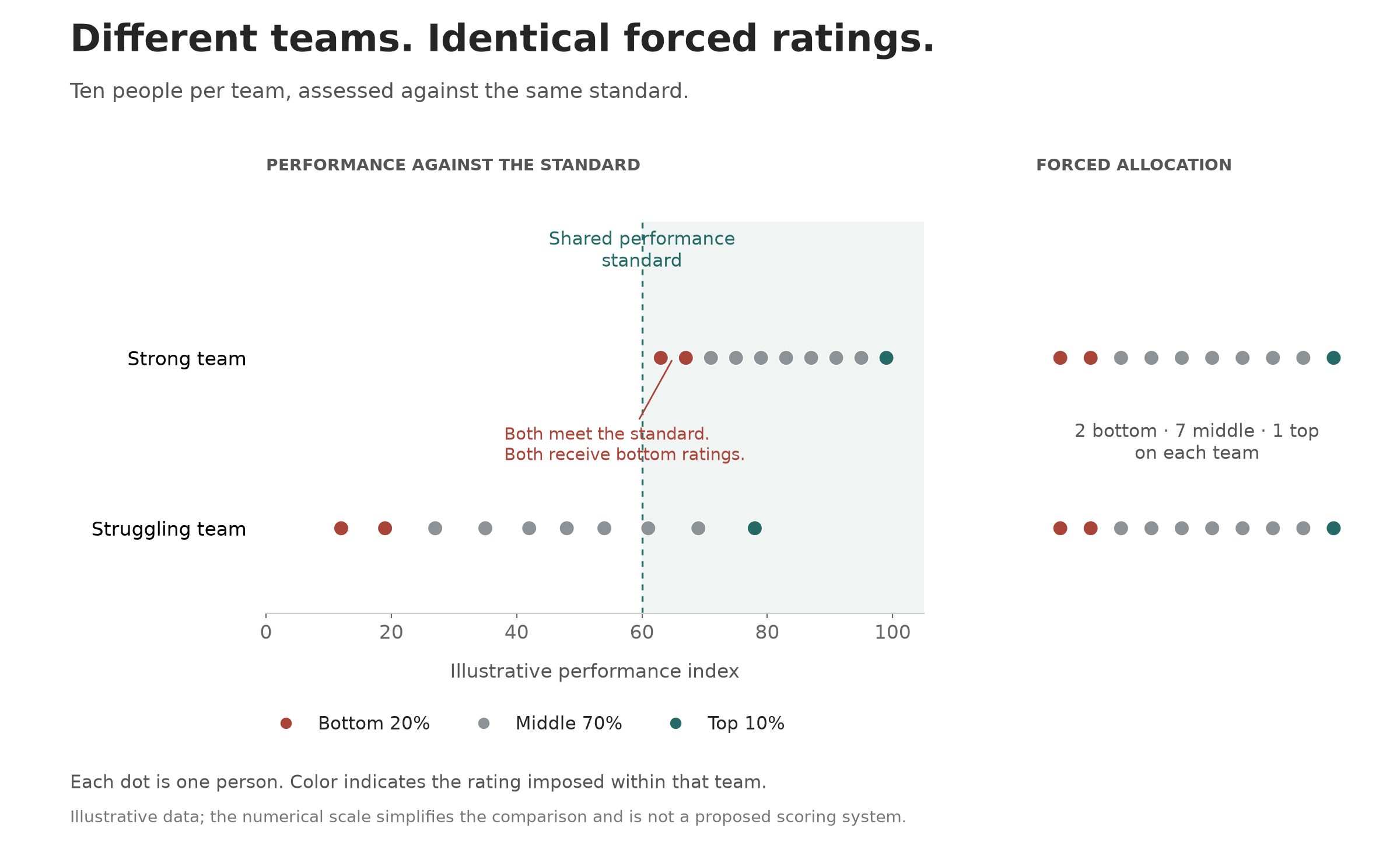
The teams are different. The required distribution is identical.
People select managers. Managers select people. Some teams develop better judgment, stronger working relationships, and more effective ways of delivering. Others accumulate problems. These differences can persist and compound.
Even if the company as a whole followed a normal distribution, it would not follow that each team should reproduce it. Nor should we assume normality in the first place. Bradley and Aguinis examined 274 performance distributions covering 200,825 teams across several kinds of work. Only 11 percent were normal. Their research concerns performance across teams, rather than ratings within a particular team, but it directly challenges the assumption that exceptional teams should be rare anomalies. Organization Science
I have seen the practical consequences several times in my career: stronger and weaker teams are leveled by the process until their ratings obscure the difference between them. The strong team has too many people above the expected distribution. The weaker team receives recognition that looks comparable on paper.
The curve is satisfied. The people who know the work are not.
Taleb makes a related point about averages: “The more nonlinearity in the response, the less informational the average.” His example is water: receiving an adequate daily supply on average is little comfort if it all arrives on one day and nothing arrives for the next nine. The variation changes the outcome. Taleb’s essay.
The narrower error in calibration does not require complicated mathematics. A description of a population cannot tell you what each selected subgroup must look like. Using it that way erases precisely the differences management should understand.
There is a moral cost here as well as a statistical one. A manager may have to explain to someone who did excellent work why that work was insufficient, when the actual insufficiency was the number of available slots. The employee is left searching for a performance lesson in a budget or quota decision.
That can change the relationship permanently.
In a study of a multinational firm, Brittany Bond found that employees downgraded because of a recognition cutoff were at least 34 percent more likely to leave voluntarily. Larger bonuses and reassurance about their prospects did not eliminate the effect. Recognition mattered independently of the money. Management Science
There is an important distinction: I always stack-rank my own reports. I consider the exercise crucial. Comparing people forces me to examine my reasons, confront inconsistencies, and challenge preferences that might otherwise remain invisible. It is particularly valuable when unexpected layoffs put decisions under severe time pressure.
That does not make my ranking automatically unbiased. It makes my reasoning available for scrutiny.
I can rank a strong team without declaring that a fixed percentage of it is weak. Relative position does not establish whether someone meets an absolute performance bar. Nor does it settle every layoff decision, where the work the company will retain also matters.
Calibration should test the evidence and the standard. Once it requires the evidence to fit the allocation, it becomes horse trading with a personnel record attached.
What scale actually requires
A growing company needs more explicit management. Expectations must survive beyond the founder’s memory. Compensation must be explainable across teams. Underperformance must be addressed consistently. Employees need a way to correct factual errors.
The annual ceremony is one way of organizing some of that work. It is not the requirement itself.
California, despite its reputation, does not generally require private employers to conduct annual performance reviews or place an at-will employee on a formal performance improvement plan before termination. At-will employment is subject to important exceptions, including unlawful discrimination and retaliation, contractual obligations, and protected rights. Company policies and agreements matter too. California termination guidance
The useful discipline is concrete: communicate standards, apply them consistently, record relevant facts, and explain the actual reasons for decisions. That is also the emphasis of the EEOC’s guidance on evaluations. EEOC guidance
An inaccurate positive review can be as troublesome as an unjustified negative one. If the record says someone performed well for years, a sudden assertion of longstanding poor performance deserves scrutiny. More paperwork does not necessarily create a better record.
This is a management argument, not legal advice. Counsel should help establish the requirements for the company’s circumstances. Leadership should then distinguish those requirements from the habits built around them.
The same distinction applies to PIPs. An improvement plan is useful when it identifies an observable gap, explains the required change, provides appropriate support, and gives the employee a real chance to succeed. If the decision to terminate has already been made, calling the intervening paperwork an improvement opportunity is dishonest.
“Fire fast” should mean confronting the problem early enough to make a clear decision. It should not mean surprising someone with a concern the manager never communicated.
Startups have an intrinsic advantage here. The people making decisions are often close enough to see the work. Scope can change, feedback can arrive, and a decision can follow without passing through several levels of interpretation.
As companies grow, review cycles arrive alongside hiring approvals, headcount controls, freezes, and pay bands. Reviews do not cause all those constraints. But together they can produce a company in which changing the team takes much longer than recognizing the need to change it.
Some of that friction buys fairness and financial discipline. Some buys only delay. Leaders need to know which is which.
Jack Dorsey’s reported 2023 memo at Block challenged the delay directly:
“Performance should be continuously evaluated, and feedback should not be queued up for later.”
He proposed ending annual reviews and PIPs, using milestones to prompt decisions, and simplifying promotions. The reported memo retained calibration and introduced visible performance ratings. It was a change in how management operated, not an end to evaluation. Reporting on the memo, reproduced memo
The principle is useful. A promotion should recognize a sustained change in responsibility when the evidence supports it, rather than wait for an annual negotiation.
But removing the calendar creates another obligation. People still need to know the bar, where they stand, and how a decision can be challenged. Otherwise continuous evaluation becomes a permanent threat. A smaller process can still be arbitrary.
How many OKRs survived the quarter?
How many times have your OKRs truly survived the quarter?
I mean remained the best use of the team’s time, with the same assumptions and priorities, after contact with customers, competitors, technical reality, and new information.
The fact that they remained in the tool does not answer the question.
Objectives and targets have uses. Boards and investors need to understand what management intends to accomplish. A team improving a stable process can benefit from a clear, measurable goal. The problem is the growing precision of commitments as they cascade further from the strategy.
A company objective becomes a departmental objective, then a team objective, then an individual score. Dependencies are shared, but accountability is divided. Revenue and retention arrive late and reflect many causes. Convenient activity metrics arrive sooner, but may say little about value.
A team can do the right thing and miss its key result. It can also hit the number while making the business worse.
Imagine a team committed to increasing activation. Midway through the quarter, it discovers that the fastest way to raise the metric also increases costly support cases and early churn. Abandoning the original approach may be the best decision it makes. A review system that penalizes the missed target teaches the team to defend the original plan next time.
Marty Cagan, once a vocal advocate of OKRs, wrote that he had stopped recommending them in the majority of companies he encountered. His criticism was specific: objectives imposed on teams without meaningful autonomy, competing functional goals, and leadership that failed to supply strategy. The framework could not compensate for the missing management. Silicon Valley Product Group
Deming’s formulation was more severe:
“Eliminate management by objective. Eliminate management by numbers, numerical goals. Substitute leadership.” The Deming Institute
I would keep useful measurements. I would stop treating a quarterly hypothesis as a contract with reality.
The military offers a better organizing idea: commander’s intent. The leader communicates the purpose, priorities, desired end state, and boundaries, then gives people authority to adapt their actions as circumstances change. The Army’s account emphasizes trust, judgment, and accepting risk so others can act without constant intervention. U.S. Army
For a company, that means explaining what must improve for the customer, which constraints cannot be violated, what resources are available, and what the team can change without asking permission. Measures help test whether the approach is working. Review triggers make it clear when assumptions need to be reconsidered.
Targets still matter. Some are aspirations; some are forecasts; some are actual commitments to customers or other teams. Leaders should say which. A contractual deadline cannot be quietly reclassified as aspirational because it became inconvenient.
A team that changes direction should explain the evidence and consequences. But changing direction in service of the objective can be evidence of leadership. We should be able to recognize that without negotiating an exception to a scoring system.
Leadership, leverage, and results
At LinkedIn, I learned a simpler way of evaluating people from Jeff Weiner: leadership, leverage, and results. I have used it since.
The difference from forced calibration is fundamental. Leadership, leverage, and results ask what the person contributed. A quota asks how many places are available.
The framework is simple enough to remember, but each word requires real judgment.
Leadership starts with the word lead. How much did the person anticipate, and how much did they merely react? Did they identify a problem before it became an escalation? Create clarity where ownership was ambiguous? Help others act with better judgment?
This applies to individual contributors as much as managers. Title does not establish leadership, and visibility can be a poor substitute for it.
Leverage asks what was created per unit of effort, and what other people can now accomplish because of it. A reusable system, a better hire, a simpler architecture, a decision that prevents months of wasted work, or someone who teaches others to solve a recurring problem can all create it.
Repeated heroics deserve appreciation. They also deserve a question: why does the organization still need the same rescue?
Results asks what actually changed. What shipped, what improved for customers, what became more reliable, what revenue or cost consequence followed? Did the improvement last?
Results combine judgment, process, hard work, collaboration, and luck. Hard work matters enormously; it is one of the inputs a person can control. But hours alone cannot tell us whether the effort was directed well. Nor should a lucky outcome erase a reckless decision.
These dimensions should remain visible separately. I would not average them into a decimal. Someone who produces strong short-term results while damaging everyone around them has created a problem that arithmetic should not conceal.
The discipline is to attach concrete examples to each judgment, appropriate to the person’s role and opportunity. It should be possible for the employee to understand the assessment and dispute a factual error.
This still requires a manager to decide. That is a feature.
What AI should do
AI makes the current system easier to perpetuate.
An employee can generate a polished self-review. Peers can generate feedback. A manager can synthesize both into a persuasive narrative. Another model can summarize it for calibration.

The prose improves. It is entirely possible that nobody learns anything.
The more useful application is reducing the cost of finding and testing evidence. An approved system can assemble dated examples, link them to their sources, preserve disagreements in peer feedback, and identify claims that have little support. It can help a manager notice that the assessment contains three recent incidents and nothing from the preceding five months.
It should also be allowed to return an uncomfortable answer: there is not enough evidence here.
That matters because the record is incomplete by construction. A person who prevents an incident may leave less visible evidence than someone who resolves one. Mentoring can be poorly documented. Quiet coordination may look less impressive than public escalation. Message volume, commits, and meeting attendance are convenient observations with weak claims to being performance measures.
I would use AI to help interrogate the record. I would not delegate employee ranking or the final compensation, promotion, or termination judgment to it. The manager must inspect the underlying evidence and own the conversation.
California’s employment regulations on automated decision systems, effective October 1, 2025, reinforce that accountability. They address discriminatory outcomes from automated systems and require preservation of relevant employment records, including automated-decision data. A human approval step does not make the underlying system irrelevant. California Civil Rights Department
AI could help us remove substantial parts of the review form. If evidence is easier to retrieve and challenge throughout the year, the case for periodically reconstructing it in prose becomes weaker.
That should be the test for the investment: how much unnecessary work disappears, and whether the remaining decisions improve.
Before the next cycle
The operating model I would use is fairly small.
Give feedback while it can still change the work. Address material underperformance when it becomes visible.
At planning intervals, reset intent and assumptions with the team. Make decision authority explicit. Do not turn each planning discussion into another rating event.
Once or twice a year, consolidate the important evidence into a short account of leadership, leverage, and results. One page should usually be enough. Ask peers specific questions about work they observed. Let employees correct factual errors.
Keep compensation allocation explicit. Performance is an input alongside scope, market conditions, internal equity, position in range, and the company’s budget. Explain the constraint that actually affected the decision. Recognize sustained changes in role when they occur, with consistent promotion standards.
Use calibration to challenge evidence and reconcile standards. Require a reason for changing a manager’s assessment. Examine patterns across managers. Do not require every team to resemble the same distribution.
This can deteriorate too. A one-page memo can become a ten-page packet. Targeted peer input can become selective evidence. Asynchronous promotions can reward access to executives. Continuous feedback can become continuous interruption. The design needs limits and periodic scrutiny, including scrutiny of the managers making the judgments.
What should a manager say when the system produces an outcome they disagree with?
Confidentiality is real. You cannot disclose other people’s compensation or private discussions. But confidentiality does not require pretending a budget decision was a performance conclusion. Explain the facts, your judgment where appropriate, the constraints, and the decision. Do not promise what you cannot deliver. Do not retreat behind “HR decided” as if managing the person stopped at the calibration-room door.
The Valley is a long game. People remember the manager who told them a difficult truth early enough to do something about it. They also remember the manager who praised their work all year and arrived in December with an explanation neither of them believed.
Trust is what leadership spends when it treats the next review cycle as inevitable.
Before opening the forms, look at the decisions the company needs to make. Keep the evidence, standards, and conversations that improve those decisions. Remove the work that merely makes them look more objective.
The employee deserves an honest assessment.
The manager owes a judgment they can explain.
No process should relieve leadership of either obligation.